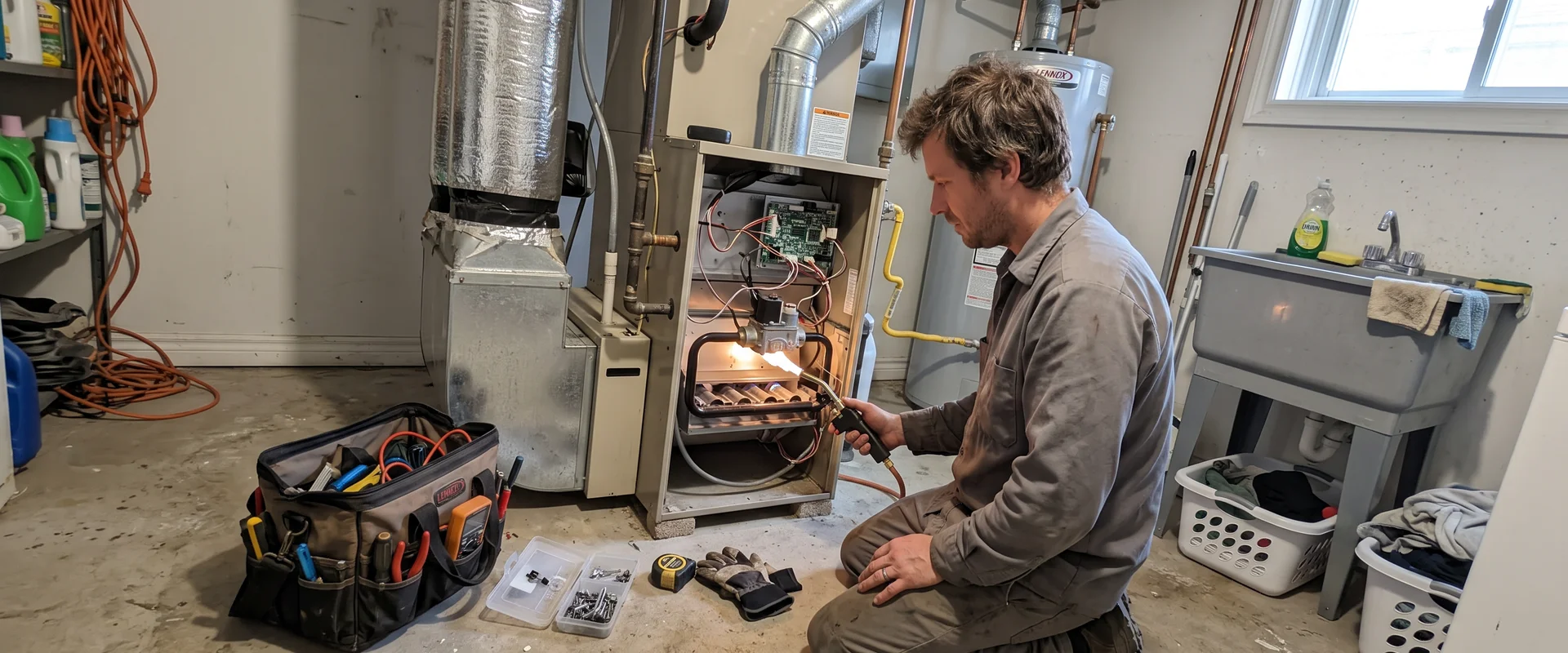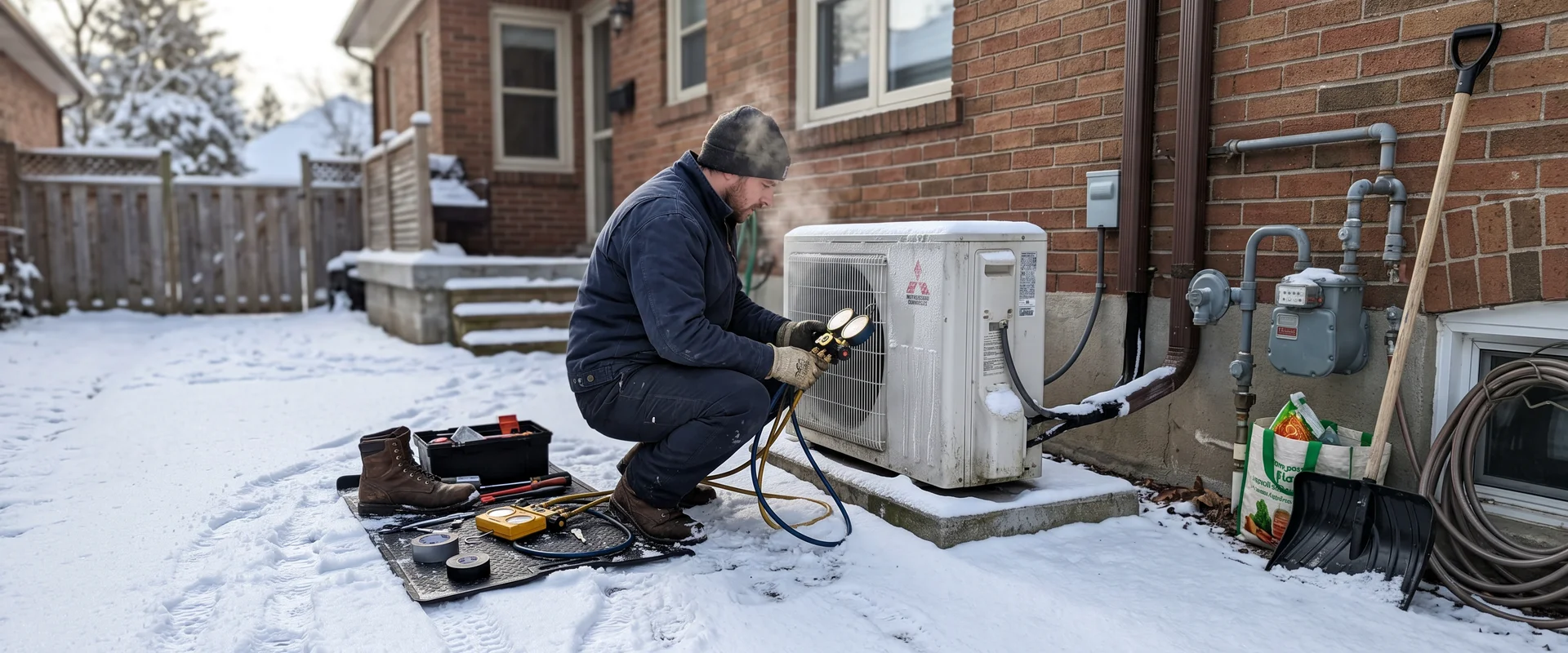
Best HVAC Toronto is a TSSA-certified HVAC contractor and HRAI member providing heat pump installation across Toronto, the GTA, and the wider Ontario region, from ducted cold-climate retrofits to dual-fuel hybrid systems and ductless heat pumps. Our licensed mechanical crew brings over 20 years of combined Ontario HVAC experience, and every installation carries a 2-year labour warranty plus 5 to 10 years of manufacturer coverage.
Will a cold-climate heat pump suit your home?
A heat pump is an air conditioner that can run in reverse. In summer it moves heat out of your house; in winter a reversing valve flips the cycle and it moves heat from the outdoor air into your house. Because it moves heat rather than creating it by burning fuel, it delivers more heat energy than the electricity it consumes, which is what makes the economics work. Unlike a geothermal (ground-source) heat pump, which draws heat from buried ground loops and needs excavation or drilling, an air-source heat pump pulls heat from the outdoor air, so it fits a standard Toronto lot without digging up the yard.
The important qualifier for Toronto is “cold-climate”. A standard heat pump loses most of its output around freezing. A cold-climate air-source heat pump, or ccASHP, uses an inverter compressor and enhanced vapour injection to hold usable capacity well below -15 degrees, with many models listed to -25 or -30. Best HVAC Toronto sizes exclusively from the NEEP cold-climate listings and the NRCan qualified product list, using published capacity at low ambient temperature rather than nominal tonnage. That distinction is the single most common reason a heat pump disappoints its owner.
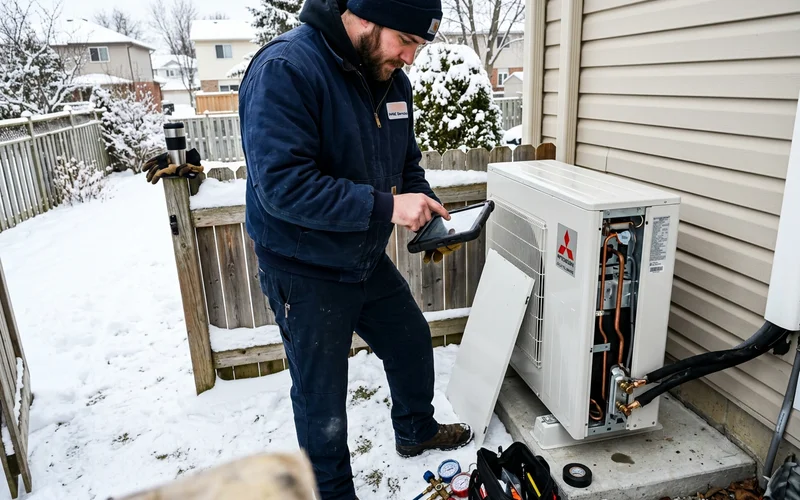
Toronto’s newer housing stock, particularly across Markham, Vaughan, Milton, and the Seaton area of Pickering, is tight and well insulated with a modest heating load. That is exactly the condition where a heat pump performs strongly. Older, leakier homes in North York, York, and central Oshawa can still work well, but often make more sense as a dual-fuel installation.
What is included in every heat pump installation
A full heating and cooling load calculation, duct capacity and static pressure assessment, electrical panel review, NEEP-listed equipment selection, outdoor unit mounted on a raised stand clear of snow accumulation, insulated and protected line set, condensate management for winter operation, control and changeover configuration, full commissioning including defrost verification, and rebate paperwork completed and submitted on your behalf.
Full electric or dual fuel: which setup fits you?
Full electric heat pump
The heat pump handles the entire heating season, with electric auxiliary heat strips covering extremes and defrost cycles. This is the right choice if you have no gas service, if you are removing an oil or propane system, or if decarbonisation is a priority. It usually requires 200 amp electrical service.
Dual-fuel hybrid
The heat pump runs down to a changeover temperature we set with you, typically somewhere between -5 and -12 degrees depending on your rates and equipment, then the existing gas furnace takes over. This captures the large majority of the season on the heat pump while keeping a reliable, high-output backup. For most Toronto homes with a healthy gas furnace, from Scarborough bungalows to two-storey detached homes in Etobicoke, this is the option we recommend.
Ductless multi-zone
For homes without ductwork, such as older semi-detached houses in East York and The Beaches heated by hot-water radiators or baseboards, or for additions, attics, and basements, a ductless heat pump in a multi-zone mini-split layout gives per-room control without retrofitting ducts. Our ductless mini-split installation page covers that route in more detail.
How much does heat pump installation cost in Toronto?
Capacity and equipment tier come first: a larger home with a higher heating load needs a larger, more capable unit. Second is the indoor side. A ducted retrofit that reuses your existing ductwork and keeps your furnace is the cheapest path; replacing the furnace with a new air handler costs more. Third is electrical, since a full electric system with auxiliary heat strips may require a service upgrade.
Fourth is ductwork condition. A heat pump moves more air at lower temperature than a furnace does, so ducts that were marginal before become a real constraint. If static pressure is too high we will say so and quote the ductwork correction, because installing good equipment on restricted ducts wastes your money.
Fifth, and working in your favour, is rebates. Eligible systems attract up to $6,500 combined through the Home Renovation Savings program and Canada Greener Homes. We confirm the exact figure for the model we are quoting, include it clearly in the proposal, and submit the application ourselves once the work is signed off.
How a cold-climate air-source heat pump moves heat
A cold-climate air-source heat pump (ccASHP) moves heat rather than generating it, which is why one kilowatt-hour of electricity can produce two to three kilowatt-hours of heating output. The system uses a refrigerant that boils at temperatures below outdoor ambient. Outside, a fan blows outdoor air across the outdoor coil, where the refrigerant absorbs heat from the air and evaporates into a gas. An inverter compressor pressurises the gas, which raises its temperature to well above indoor setpoint. The hot gas travels through the refrigerant line set to the indoor coil, where a blower moves indoor air across the coil, extracting the heat into the home’s air stream. The refrigerant, now cooled and liquid again, returns to the outdoor unit and the cycle repeats.
The “cold-climate” part is engineered from three specific technologies: an enhanced vapour injection compressor that maintains heating capacity as outdoor temperatures drop, a variable-speed inverter that ramps output from about 30% to 100% to match load, and a defrost cycle that reverses refrigerant flow to melt frost off the outdoor coil during Toronto’s freeze-thaw winters. Modern ccASHPs from Mitsubishi, Daikin, Bosch, Carrier, and Lennox maintain 100% of nameplate heating capacity down to about -15°C and continue producing usable heat down to -25°C or lower. Below the balance point, an auxiliary heat source (electric strip or gas furnace in dual-fuel setups) engages to cover the shortfall. As a manufacturer-authorized dealer for Lennox, Carrier, Trane, and Bosch, we register the equipment warranty with the manufacturer on your behalf.
Do heat pumps work in a Toronto winter?
Yes. This is the most common objection and the easiest to answer with data. The NEEP Cold Climate Air-Source Heat Pump Specification lists dozens of models rated for full capacity at -15°C and continued operation to -25°C or lower. Toronto’s design heating temperature is -22°C, which occurs on the coldest 1% of hours in a normal winter, meaning a properly-sized ccASHP handles the design load directly for roughly 99% of the heating season. On the remaining coldest hours, the auxiliary heat source engages, which is why balance point selection matters.
Real-world Toronto performance data from the last three winters: NRCan monitoring showed ccASHP systems maintaining Coefficient of Performance (COP) of 2.5 to 3.0 at -10°C, dropping to about 1.8 to 2.2 at -20°C. Even at -20°C the heat pump is still producing about twice the heat per kilowatt-hour of electricity input as an electric resistance furnace would. Homeowners with dual-fuel setups (heat pump for temperatures above balance point, gas furnace below) typically see the gas furnace run for 8-15% of the heating season and cover the coldest hours. Homeowners with all-electric setups (heat pump plus electric backup) see the electric backup run for 3-8% of the season depending on home envelope. Both configurations deliver dramatically lower operating costs than gas-only.
What heat pump rebates are available in Ontario in 2026?
Three programs stack on eligible heat pump installations. The Home Renovation Savings (HRS) program pays $2,000 for a gas-plus-heat-pump hybrid and up to $7,500 for a full electric ccASHP replacing gas heat. HRS requires a pre-retrofit EnerGuide evaluation to establish baseline, a post-retrofit EnerGuide evaluation to confirm the upgrade, and installation by a participating contractor. We coordinate both evaluations through a Registered Energy Advisor and file the rebate application on your behalf. Typical HRS turnaround from install to rebate cheque is 8-12 weeks.
The Canada Greener Homes Loan continues to offer an interest-free loan of up to $40,000 for eligible retrofits including heat pumps. Terms are 10 years, no payments during the first year, and the loan is repayable on sale of the home or refinancing. The BetterHomesTO Home Energy Loan Program (HELP) is Toronto-specific and offers up to $125,000 at low interest, repayable through the property tax bill over up to 15 years. HELP is transferable if the home is sold, which is unusual for consumer financing and makes it attractive for planned improvements. All three programs stack: a full ccASHP install on a typical Toronto detached home can attract $6,500 to $7,500 in direct HRS rebate, plus a $10,000 to $15,000 interest-free Greener Homes Loan, plus HELP financing to cover the remaining balance. Best HVAC Toronto handles the paperwork end-to-end at no additional cost.
Is your home ready? Six questions to answer first
Six questions determine heat pump candidacy. First, what fuel do you heat with today? Homes on gas typically go dual-fuel (heat pump plus retained gas furnace); homes on electric resistance, oil, or propane usually go full-electric because the operating cost gap is enormous. Second, does your home have functional ductwork? Central heat pumps use existing ducts, so a home with usable ductwork is a straightforward candidate. Homes without ducts go to a ductless mini-split setup, which is still a heat pump but with different distribution.
Third, what is your electrical panel capacity? A 100-amp panel handles most heat pump installs when the auxiliary is dual-fuel (gas backup); a full-electric heat pump with electric strip backup typically needs a 200-amp panel or a load calculation confirming headroom. Fourth, is your home envelope reasonable? Poorly insulated homes with high heat loss increase heat pump load and reduce comfort at the coldest temperatures. Fifth, do you plan to stay in the home long enough to recover the upfront cost? Payback periods run 5-9 years depending on fuel swap, rebate stacking, and current utility rates. Sixth, are you eligible for the rebates? HRS requires the EnerGuide evaluation, so if you cannot arrange the pre-retrofit visit, the direct rebate is not available (though the loan programs still are). We answer all six during the free estimate and give you a clear yes-or-no with the specific numbers for your home.
Heat pump vs gas furnace: which costs less to run?
The operating-cost math depends on outdoor temperature and your specific utility rates. At Enbridge natural gas rates of about $0.13 per cubic metre in early 2026 and a 95% AFUE gas furnace, the delivered heating cost is roughly $0.036 per kilowatt-hour of heat. At Toronto Hydro time-of-use average electricity of about $0.13 per kilowatt-hour, a ccASHP delivering a seasonal COP of 2.8 produces heat at roughly $0.046 per delivered kilowatt-hour. That is about 28% more expensive than gas on operating cost alone, before rebates or capital cost.
Rebates change the equation. On a typical Toronto detached home replacing a 15-year-old furnace with a full-electric ccASHP: capital cost is about $12,000 after $7,500 HRS rebate (net $4,500 out of pocket), operating cost is about $1,800 per winter for heating versus $1,400 for a comparable new gas furnace. The $400 annual operating gap is offset by the reduced maintenance cost (no combustion, no gas piping, no annual safety inspection), and the ccASHP also provides cooling year-round, saving another $400-600 versus a standalone AC. Payback lands in about 7-9 years on operating cost alone. Payback drops to 4-6 years on a dual-fuel setup, and to 3-5 years on homes replacing oil or propane. The comparison always depends on your specific bill history, which we review during the estimate.
Dual-fuel hybrid vs all-electric heat pump systems
Dual-fuel hybrids pair a heat pump with a gas furnace, using the heat pump for temperatures above a set balance point and switching to the gas furnace below. Standalone heat pumps use electric resistance strips for backup. The choice depends on your gas connection, panel capacity, and operating cost preference.
Dual-fuel makes sense when: you already have a gas connection and a functional gas furnace, your electrical panel is 100-amp and adding a full-electric heat pump would trigger a panel upgrade, or you want the fastest payback on rebate stacking. Balance point is usually set at -5°C to 0°C, meaning the heat pump handles roughly 80-90% of the heating season and the gas furnace handles the coldest 10-20% of hours. Operating cost is lowest on this configuration because you use whichever fuel is cheaper at any given outdoor temperature. Rebate is $2,000 through HRS for the hybrid pairing.
Standalone heat pumps make sense when: you have no gas connection or want to disconnect from Enbridge, your electrical panel supports 200-amp service or the load calc confirms headroom, or you want full electrification for environmental or resale reasons. Backup is provided by 5, 8, or 10-kilowatt electric strips that engage below balance point. Operating cost is higher on the coldest 3-8% of hours (electricity resistance is 100% efficient but pricier per delivered kilowatt-hour than gas at current rates), but the rebate is larger: up to $7,500 HRS for a full electric replacement. Standalone also removes the gas safety inspection, gas line maintenance, and any Enbridge Red Tag risk on the furnace. We model both configurations during the estimate so you can decide with the specific numbers.
Manual J sizing and HSPF2 ratings explained
HSPF2 stands for Heating Seasonal Performance Factor version 2 and rates a heat pump’s heating efficiency over a typical Canadian heating season. The number is expressed in BTU of heating delivered per watt-hour of electricity consumed. A HSPF2 of 8.0 means the heat pump delivers 8 BTU of heat per watt-hour on average over the season; a HSPF2 of 10.5 delivers 31% more heat per unit of electricity. Higher HSPF2 = lower operating cost. Canadian minimum is 7.5 HSPF2. Rebate-eligible ccASHPs run 8.5 to 10.5 HSPF2. Premium inverter units from Mitsubishi, Daikin, and Carrier hit 10.5-11+ HSPF2 with matched SEER2 above 20.
Sizing uses a Manual J load calculation for the design heating condition (-22°C for Toronto) and a Manual S equipment selection to match a ccASHP to the load without oversizing. Oversizing a heat pump is costly: an oversized inverter compressor spends more time at partial load, which is less efficient than mid-range load, and the outdoor unit is physically larger and more expensive than needed. Undersizing forces excessive auxiliary heat use in cold snaps, driving up operating cost and reducing comfort. Correct sizing usually places the balance point at -5°C to -15°C for Toronto, meaning the heat pump alone handles the vast majority of the heating season without auxiliary. We run Manual J and Manual S on every install and share both worksheets in writing so you can see the specific model and sizing recommended for your home.