What every AC repair and installation includes
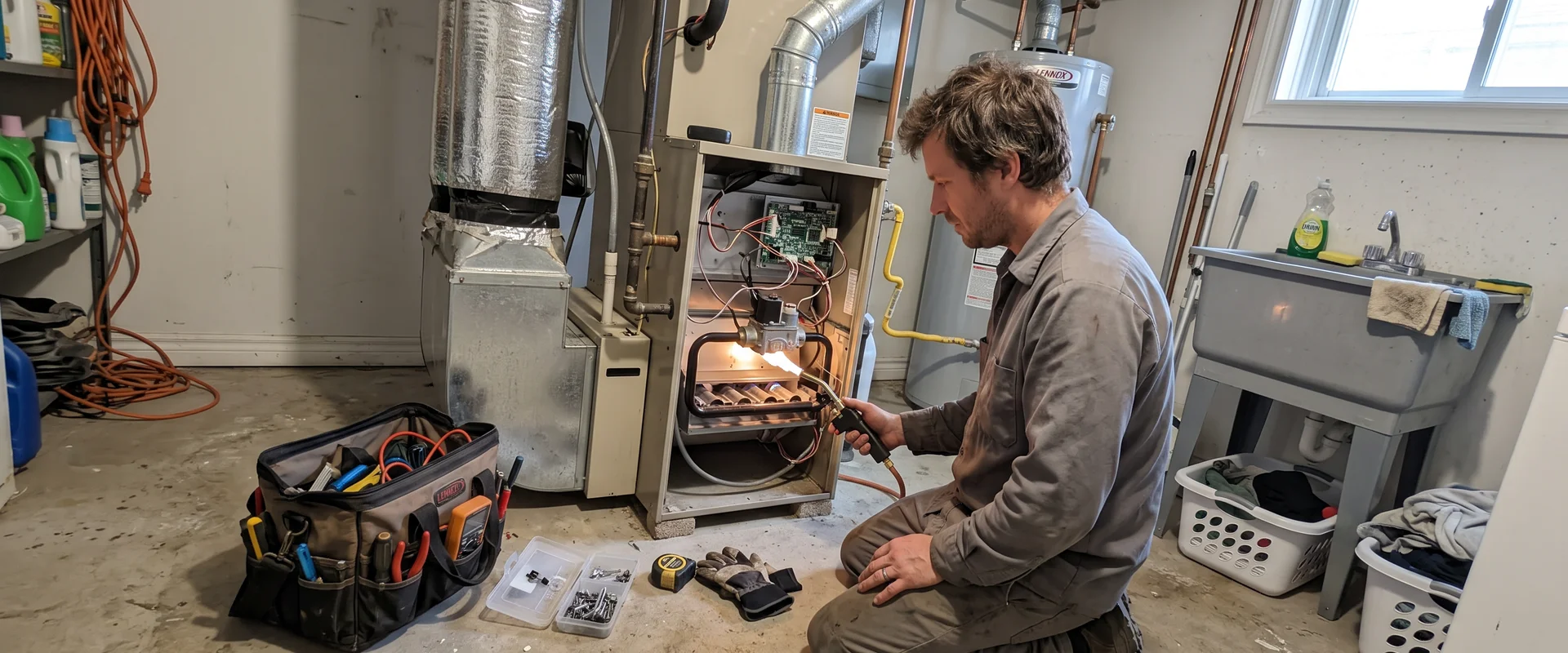
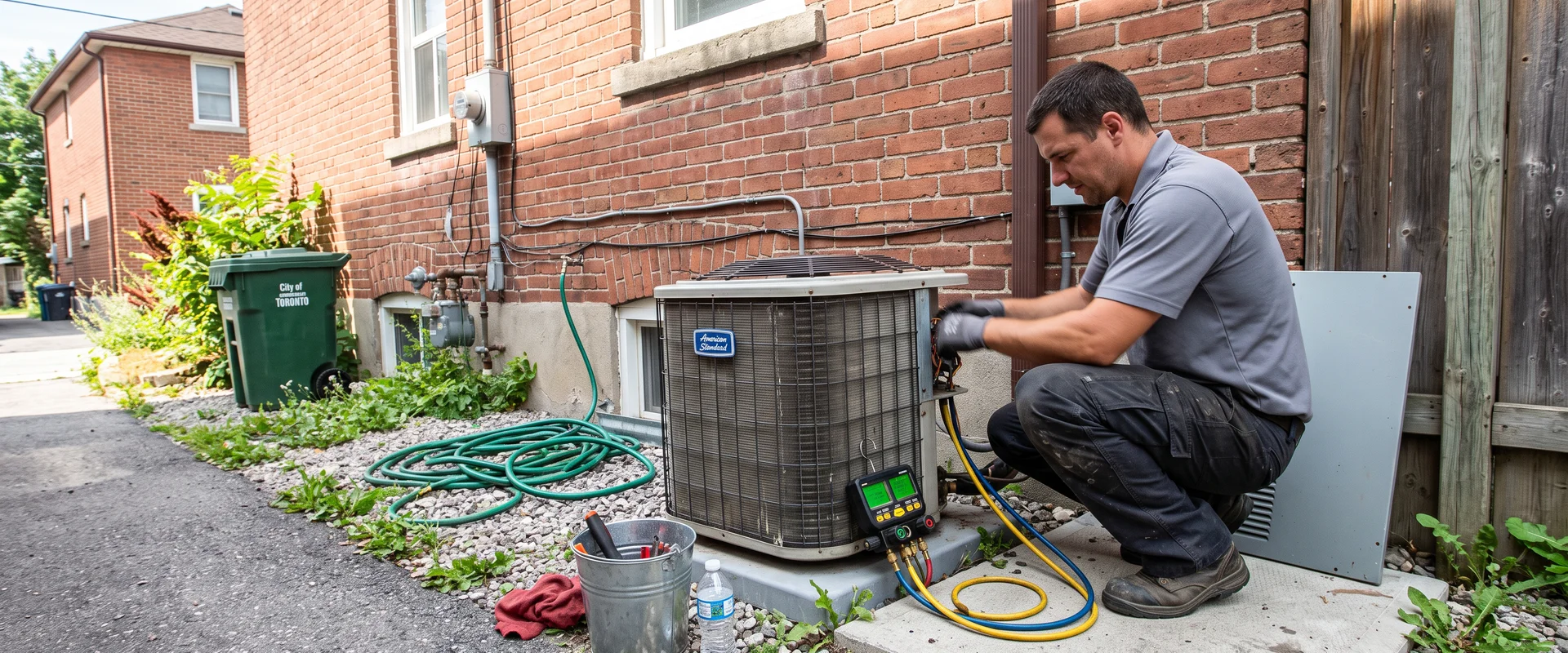
Best HVAC Toronto is an HRAI member HVAC contractor that installs central air conditioning sized to your home’s actual cooling load and provides 24/7 emergency AC repair, with a typical two-hour response, when a Toronto heat wave takes a system down. That covers everything from a failed run capacitor on a Tuesday night to a full system replacement with a matched evaporator coil, new line set, and thermostatic expansion valve, or a cold-climate heat pump if you want one unit for summer cooling and winter heating.
The single biggest difference between a comfortable house and a merely cool one is sizing. Cooling capacity is easy to oversupply, and an oversized condenser satisfies the thermostat in a few minutes, shuts off, and repeats. The air temperature drops, but the coil never runs long enough to condense moisture out of it. The result is the complaint we hear constantly in July: the thermostat says 22 degrees and the house still feels damp. A Manual J load calculation, matched equipment, and correct airflow in CFM solve that properly.
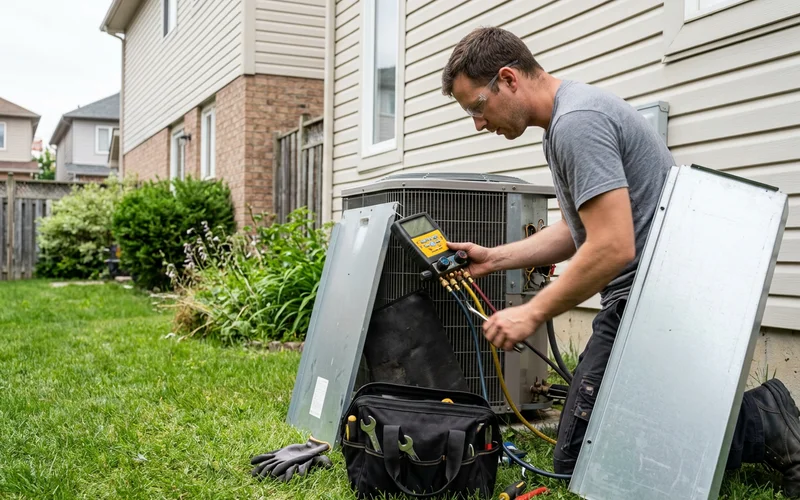
Commissioning matters just as much. Best HVAC Toronto technicians pull a deep vacuum on the line set to remove moisture and non-condensables, weigh the refrigerant charge in rather than guessing from pressures alone, verify subcooling against the manufacturer’s specification, and measure the temperature split at the supply registers. A system charged by feel can look fine on a mild day and fail badly at 33 degrees.
What is included in every AC installation
Removal and disposal of the old condenser and coil, a new right-sized condensing unit with a scroll compressor, a matched evaporator coil with a thermostatic expansion valve, a new line set where required, a level pad and proper clearances outdoors, condensate drainage with a safety switch, electrical disconnect, full commissioning, and manufacturer parts coverage registered on your behalf.
Common air conditioning problems in Toronto homes
The system runs but the house will not cool
Usually low refrigerant from a leak, a dirty condenser coil that cannot reject heat, or a failing compressor. Refrigerant does not get consumed, so if the charge is low there is a leak, and topping it up without finding the leak just postpones the same call next summer.
The outdoor unit hums but the fan does not spin
Nine times out of ten this is a failed run capacitor, an inexpensive part we carry. Left running in that state, though, it will take the compressor with it, so it is worth switching the system off until we arrive.
Ice on the coil or the copper line
Restricted airflow or low refrigerant. Check the filter first, then the returns. If both are clear, it is a refrigerant problem and needs proper leak detection rather than a top-up.
Water pooling near the furnace or air handler
A blocked condensate drain or a failed condensate pump. Easy to fix, and worth fixing quickly because the overflow lands on the furnace controls sitting directly beneath it.
Some rooms never cool
A distribution problem rather than a capacity problem. Second floors in Vaughan and Markham two-storeys, and the third-floor rooms of older semi-detached homes in Etobicoke and the Annex, are the classic cases, and the answer is normally return-air correction and damper balancing, or a ductless mini-split for the one stubborn room, rather than a bigger condenser.
What drives central air conditioner installation cost?
Tonnage comes first and is set by the load calculation, not by the old unit’s nameplate. Efficiency tier is second: entry-level single-stage equipment sits near $4,000 installed, while two-stage and inverter-driven systems with higher SEER2 ratings run toward $8,000 and deliver noticeably better humidity control. If you are replacing the condenser anyway, it is also worth pricing a cold-climate heat pump, which cools the same way and attracts Ontario Save on Energy rebates that a straight air conditioner does not.
Third is what can be reused. If the existing line set is the right size, in good condition, and compatible with the new refrigerant, it may be reusable, which saves both material and disruption. If not, a new line set is needed. Fourth is the evaporator coil, which must be properly matched to the condenser for the rated efficiency to be achieved. Fifth is electrical and siting work: a new disconnect, a level pad, or relocating a condenser away from a bedroom window all add cost.
Best HVAC Toronto assesses each of these during the free on-site estimate and gives you a written fixed price before any work begins, backed by a 2-year labour warranty on the installation and 5 to 10 years of manufacturer coverage depending on the equipment.
Why is my AC blowing warm air?
Warm air from the supply vents on a hot day almost always points to one of five faults. A dirty filter is first, and it is more common than most homeowners realise. A clogged filter starves the evaporator coil of airflow, the coil freezes into a solid block of ice, and the air passing over it is neither cool nor moving well. Low refrigerant is second, either from a slow leak in the copper line set or from a mechanical shock that opened a joint. Modern R-410A and the new R-454B refrigerants both require a licensed technician to recharge, and the leak needs to be found and sealed first or the recharge lasts weeks, not seasons.
A failed capacitor is third. The dual-run capacitor on the condenser starts the compressor and fan motor. When it weakens, the outdoor unit hums but nothing spins, or it spins briefly and then stops. Fourth is a contactor that has pitted or welded closed, cutting power to the compressor. Fifth is thermostat wiring: a chewed low-voltage wire in an attic or crawlspace, or a nest of ants in the contactor, will interrupt the call for cooling before the compressor ever runs.
Before you call, swap the filter, set the thermostat to Cool and setpoint below room temperature, and check the outdoor breaker and the disconnect at the condenser. If those are all clear and the air is still warm, emergency dispatch sends the nearest available technician to you, from Scarborough to Mississauga, and most heat wave calls are diagnosed and repaired on the same visit.
When to call for air conditioning repair in Toronto
A well-maintained AC gives clear warnings before it fails outright. Weak airflow at the supply registers is the most common early signal, usually caused by a partially clogged filter, a failing blower motor, or a return duct that has come loose in a crawlspace. Grinding, buzzing, or screeching noises from the condenser are the second signal, often bearings in the fan motor or a compressor showing wear.
Short cycling, where the AC runs for two or three minutes and shuts off repeatedly, is the third. It usually means the unit is oversized, low on refrigerant, or has a failing pressure switch. Rising humidity at the same thermostat setpoint is the fourth, and it usually means the coil is dirty or the blower is running too fast to condense moisture out of the air. Rising electricity bills without an occupancy change is the fifth: the compressor is working harder to hit the same setpoint because of low refrigerant, a dirty coil, or a bad capacitor drawing extra amps.
Age is the sixth. R-22 systems installed before 2010 are on borrowed time because the refrigerant has been phased out and recharges are prohibitively expensive. R-410A systems installed 2010 to 2024 have another decade of useful life if maintained. New R-454B and R-32 systems installed from 2025 onward are the current standard. When two or more signals apply on a unit above 10 years, replacement usually wins on operating cost within three summers.
What SEER2 rating do I need in Toronto?
SEER2 replaced SEER as the North American cooling efficiency rating in 2023. The change is not just a rename: SEER2 uses a more realistic test procedure with higher external static pressure that better reflects installed conditions, which is why SEER2 numbers run about 4-5% lower than the old SEER for the same unit. The Canadian minimum for split-system central AC is 14.3 SEER2. For heat pumps installed for cooling, the minimum is 15.2 SEER2.
The right rating for a Toronto home depends on run hours and rebate stacking. Toronto cooling season is short but intense, so the operating-cost gap between a 14.3 SEER2 baseline and a 16 SEER2 unit is roughly $60-90 per season on a typical detached home. That gap widens to $150-200 per season at 18 SEER2 with an inverter compressor. The Ontario rebate programs currently reward 16+ SEER2 installations, which typically pushes the effective purchase price of a higher-tier unit below the baseline after incentives. The right answer for most Toronto homes is 16-17 SEER2 with a two-stage or variable-speed compressor: quieter operation, better humidity control, meaningfully lower bills, and rebate eligibility. Homes with heat pump plans should look at 17+ SEER2 with matched HSPF2, since the unit will run year-round rather than seasonally.
How to size a central AC for your home
AC sizing uses the same ACCA Manual J load calculation as furnace sizing, but with different design conditions and different consequences for getting it wrong. Toronto’s design cooling temperature is 30°C outdoor with 70% relative humidity, and the calc solves for the cooling load in BTU per hour, converted to tons (12,000 BTU/hr = 1 ton). Typical Toronto detached homes land between 2 and 3.5 tons of cooling; townhouses and semis run 1.5 to 2.5 tons.
Oversizing an AC is worse than oversizing a furnace. An oversized unit cools the air quickly, satisfies the thermostat, and shuts off before it has run long enough to condense moisture out of the air. The result is a cold, clammy house: the temperature reads correct but the humidity is 65% or higher and the space feels sticky. Oversized systems also short-cycle, which shortens compressor life and wastes energy on start-stop cycles. Undersizing is rarer: an undersized AC runs continuously on the hottest days without reaching setpoint, but at least it dehumidifies well. The correct size, chosen from Manual J on your specific home, delivers even temperatures, humidity in the 45-55% range, and reasonable run times. Nameplate matching from the old unit is unreliable because the old unit was often oversized to begin with.
What the R-410A to R-454B refrigerant change means
The refrigerant industry is transitioning away from R-410A because of its global warming potential (GWP of 2,088) toward lower-GWP alternatives. R-454B (GWP 466) and R-32 (GWP 675) are the leading replacements in North American residential systems. Since January 2025, newly manufactured split systems in Canada use R-454B or R-32, and in 2026 nearly every new installation runs on one of the two. Existing R-410A systems can be serviced indefinitely, but the refrigerant gets progressively more expensive as production winds down.
What this means for a Toronto homeowner: if you’re replacing your AC now, the new system will run on R-454B or R-32. If your unit is R-410A and needs a repair or refrigerant recharge, the recharge is still available at normal cost through the current season. If your unit is R-22 (pre-2010) and needs refrigerant, replacement almost always wins because R-22 recharges now cost more than a partial payment on a new system. R-454B is mildly flammable (A2L classification), which changes the leak detection and service protocols. Only technicians trained on A2L refrigerants can service the new systems, and every one of ours holds current A2L certification alongside EPA 608 credentials. The physical performance of R-454B is equivalent to R-410A: same cooling capacity, similar efficiency, same expected lifespan.
Repair or replace your air conditioner? Run the numbers
The half-rule applies to AC replacements the same way it applies to furnaces. If a repair would cost more than half the price of an equivalent new unit, replacement usually wins on operating cost within three summers. On a typical Toronto detached home the math looks like a $2,000 major repair (compressor swap, coil replacement, R-410A recharge above 3 pounds) versus a $4,500 to $8,000 replacement including installation and permits. That means a $2,500 repair on a 10-year-old unit is a strong replace signal.
Age matters more with AC than with furnaces because efficiency has jumped meaningfully in the last decade. A 12-year-old 13 SEER unit runs about 25% less efficiently than a current 17 SEER2 unit at the same cooling output, and refrigerant cost is another driver: R-22 systems installed before 2010 are effectively unfixable once they lose refrigerant. Below 10 years, repair almost always wins. From 10 to 15 years, the decision hinges on the specific repair and rebate stacking. Above 15 years, replacement usually wins even on smaller repairs. If your AC uses R-22, replacement wins on any refrigerant repair regardless of age.
Safety and comfort flags override the math. Refrigerant leaks near living spaces, especially with A2L refrigerants, are handled as replacement conversations rather than repair. Persistent humidity problems that survive proper filter and coil cleaning point to oversizing or coil damage that a load calc-and-replace conversation solves. Our estimate always includes the replace-versus-repair math same-day so you can decide with the actual figures in hand.
Central AC vs ductless mini-split
Central AC and ductless mini-splits solve the same problem (cooling a home) with fundamentally different equipment. Central AC uses a single outdoor condenser and a matched evaporator coil sitting on top of the furnace, with cool air distributed through the existing ductwork. It is the right choice for any home with functional ducts, and it delivers the lowest cost per ton of cooling capacity for the whole house.
Ductless mini-splits use one outdoor unit connected to individual indoor air handlers (one per room or zone) with a refrigerant line set instead of ducts. They are the right choice for homes without ducts, additions where extending duct is impractical, garages and basements finished after the fact, condos that cannot modify the central system, and any application where per-room zoning matters more than whole-house uniformity. Multi-zone ductless setups can handle up to 8 zones from a single outdoor unit.
Cost per zone favours central AC in ducted homes: a 2.5-ton central system runs $4,500 to $7,000 installed and cools the whole home, while a 3-zone ductless system runs $9,000 to $15,000 for equivalent capacity. Per-zone cost favours ductless for additions and specific rooms where central AC would require duct extension that itself costs more than the ductless install. Efficiency favours modern inverter mini-splits, which routinely hit 20+ SEER2 and 10+ HSPF2 for year-round operation. The right answer depends on your existing infrastructure: we run the numbers both ways during the estimate and let the specifics of your home decide.