Is a ductless mini-split heat pump right for your space?
Best HVAC Toronto has installed residential HVAC systems across Toronto and the GTA since 2005, and a ductless mini-split is the most direct way our TSSA-certified HVAC technicians add air conditioning and efficient heat to a space the ductwork never reached.
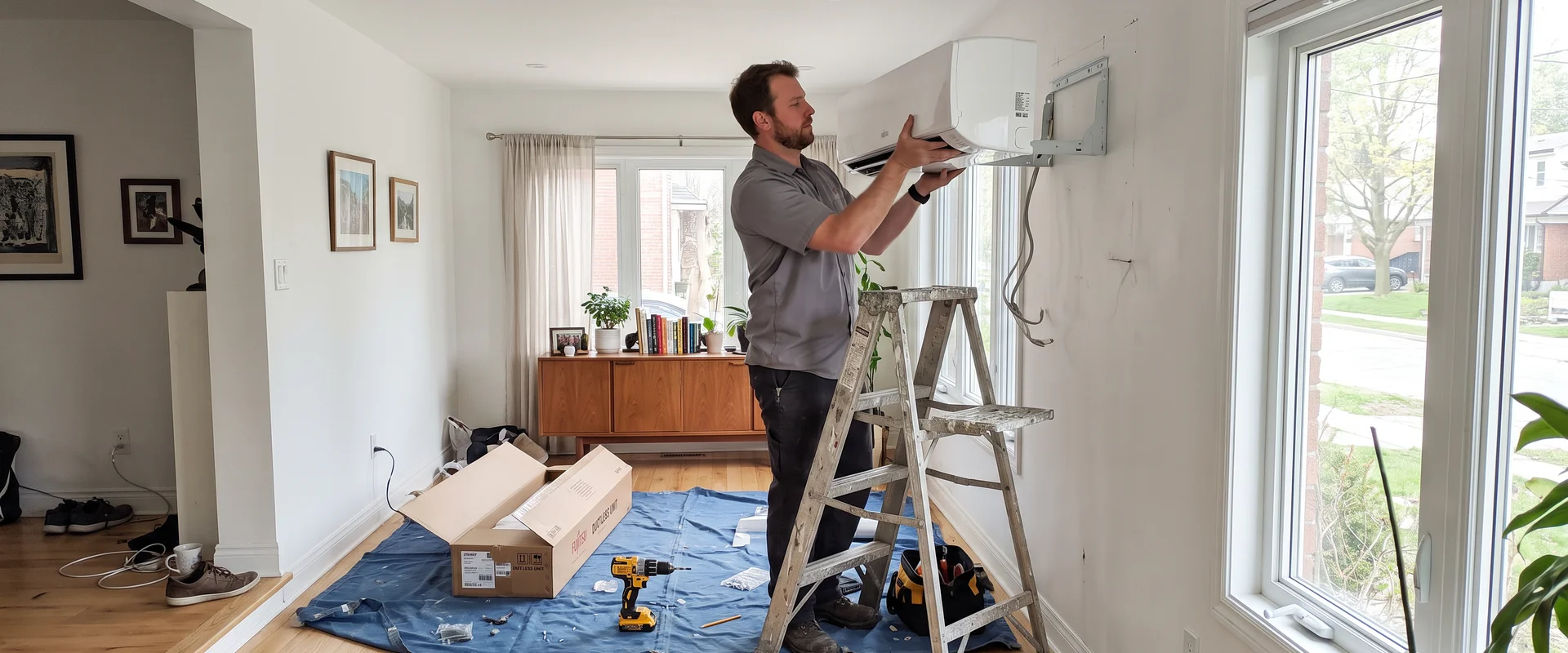
A ductless mini-split is a heat pump split into two parts: a compact outdoor condenser and one or more indoor heads mounted on a wall, in a ceiling, or at floor level. Refrigerant lines run between them through a single small wall penetration, so there is no ductwork to install and no ceilings to open up. Each indoor head has its own thermostat, so each zone holds its own temperature independently.
The case for a mini-split is strongest wherever ducts do not reach or cannot cope. Home additions built after the original heating system was designed, finished attics with sloped ceilings, basements that were completed years later, converted garages, sunrooms, laneway and garden suites, and condos are all classic cases. So is the single stubborn room in an otherwise comfortable house, like the west-facing office above the garage in an Etobicoke or North York backsplit that hits 30 degrees in July while the rest of the house is fine. Extending ductwork to solve that problem is expensive and disruptive; a single-zone mini-split solves it in a day.
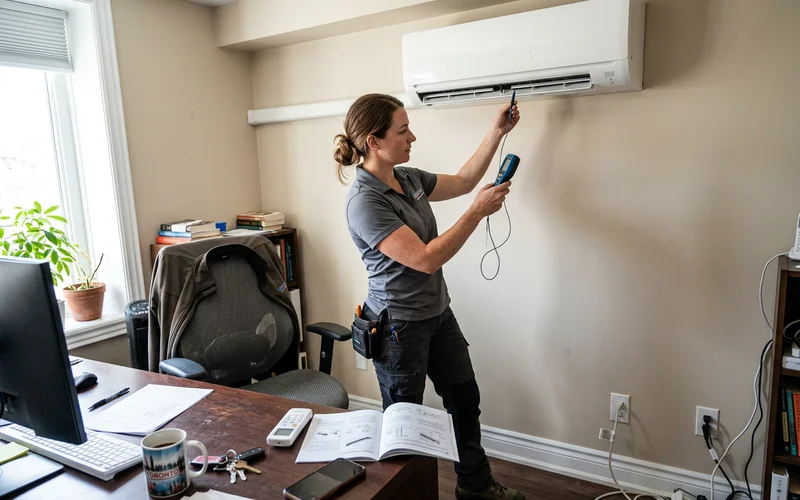
Every mini-split we install is a heat pump, so it heats as well as cools. For spaces you actually live in through the winter, we specify cold-climate models that hold useful capacity below -15 degrees rather than falling back on portable heaters in February. For a garage workshop or a shoulder-season sunroom, a standard model is usually the sensible economy.
What is included in every mini-split installation
Room-by-room load assessment, zone sizing, indoor head placement planning, outdoor unit siting for noise and snow clearance, wall penetration sealed and finished, insulated line set in a paintable cover, condensate drainage, electrical connection and disconnect, deep vacuum and verified refrigerant charge, heating and cooling tested on every zone, controls handover, manufacturer parts coverage registered on your behalf, and a 2-year labour warranty on the installation.
Single-zone, two-zone, or multi-zone: which fits?
Single zone
One indoor head and one outdoor unit. The simplest and cheapest option, ideal for a single problem room, an addition, a laneway suite, or a garage.
Two zone
Two indoor heads sharing one outdoor condenser. The most common configuration we install, typically covering a finished basement plus a home office, or two upstairs bedrooms.
Multi zone
Three to five indoor heads on one outdoor unit. Lower cost per zone and only one condenser outdoors, but it needs careful sizing. Fitting identical heads in rooms of very different sizes leads to short-cycling in the small rooms, which is the most common design fault we see in systems installed by others.
Indoor unit styles
Wall-mounted heads are the standard and least expensive. Ceiling cassettes suit rooms where wall space is limited and give a more discreet result. Floor consoles work well under windows in rooms with sloped ceilings, such as the finished attics common in Toronto’s semi-detached and row houses. In condos and stacked townhouses, the usual layout is a slim wall head on the balcony-side wall with the condenser on the balcony or a wall bracket, once the condo board has approved the exterior unit.
What affects ductless mini-split installation cost in Toronto?
Zone count comes first, though the cost per zone falls as zones are added to a shared outdoor unit. Second is capacity per zone, driven by room size, window area, and insulation rather than a rule of thumb.
Third is the equipment tier: cold-climate models with enhanced low-temperature performance cost more than standard ones, and ceiling cassettes cost more than wall heads. Fourth is line set length and routing complexity, since a head on the far side of the house from the practical condenser location needs a longer, more involved run.
Fifth is electrical. Some installations need a new dedicated circuit and disconnect, which we identify during the site visit. All of this goes into a written fixed price before any work begins.
How an inverter heat pump heats and cools without ducts
A ductless mini-split system consists of one outdoor unit (the condenser and inverter compressor) connected by a refrigerant line set to one or more indoor units (the air handlers, mounted on walls, floors, or in ceilings). Unlike a central air conditioning system that pushes air through ducts, each indoor unit blows conditioned air directly into the room it serves. In cooling mode, refrigerant absorbs heat from indoor air at the indoor unit’s coil and releases it outside at the condenser. In heating mode, the refrigerant flow reverses, absorbing heat from outdoor air and delivering it inside. This makes ductless systems heat pumps by nature: they cool and heat from the same equipment year-round.
The “mini” in mini-split refers to the compact size of the indoor units, which are typically 30-40 inches wide and 12-14 inches tall for wall-mount configurations. The line set (two insulated copper refrigerant lines plus power and communication cables) runs through a 3-inch hole in the wall to the outdoor unit. The largest multi-zone outdoor condensers support up to 8 indoor units, though most homes use two to five, each with its own thermostat and independent operation. Modern inverter mini-splits from Mitsubishi Electric, Daikin, LG, and Fujitsu ramp compressor speed continuously to match load rather than cycling on and off, which is why they hit 20+ SEER2 and 10+ HSPF2 ratings that central systems rarely match.
Which rooms benefit most?
Ductless makes sense in specific room types where central HVAC would be difficult or impossible to extend. Additions and finished basements top the list: rather than extending ductwork through joists and walls (which is expensive and often not feasible), a single ductless zone conditions the added space independently. Garages converted to workshops, gyms, or offices are the second common use, since heating and cooling a garage from central HVAC is inefficient and rarely comfortable. Sunrooms and enclosed porches are third: these spaces have high solar gain in summer and rapid heat loss in winter that ductless handles precisely.
Attic bedroom conversions are fourth, where duct extension to a second-floor conversion is impractical or would require sacrificing ceiling height. Older Toronto homes with no ductwork at all (typical for pre-1960s brick semis and detached houses on hot-water radiators in the Annex, Leslieville, Riverdale, and East York) are the fifth use, where a whole-home ductless system provides cooling and supplemental heating without ripping open walls to install ducts. Master bedrooms in split-level homes with poor zone control from the central system are the sixth: adding a ductless head to override the central zoning gives sleep-quality control without touching the main HVAC. In each case, the alternative is either living with poor comfort or spending substantially more to extend central distribution.
Running costs, rebates, and payback in Ontario
Ductless mini-split costs run $3,500-$8,000 per zone installed depending on capacity and features. A basic single-zone 9,000-BTU wall-mount unit for a small room lands at the $3,500 end; a premium 24,000-BTU multi-zone-ready outdoor unit with a high-end indoor head runs $7,500-$8,000. Multi-zone systems price down per zone as zones are added: a 3-zone system typically runs $9,000-$15,000 total, less than three separate single-zone systems would cost individually. Cost drivers beyond zone count include line set length (long runs through joists add labour), electrical work (new dedicated circuits, subpanel work if load capacity is tight), and indoor head style (wall-mount is cheapest, floor-mount slightly more, concealed ceiling-cassette the most expensive).
Payback in Ontario depends on what the mini-split replaces. Replacing electric baseboard heat: 4-6 year payback on operating cost alone because heat pumps use one-third the electricity for the same heat output. Adding cooling to a home that previously had none: no direct payback (cooling is a comfort purchase, not a cost saving), but the value shows in comfort, sleep quality, and home resale. Replacing an aging window AC with a permanent ductless: 6-9 year payback on efficiency alone. Ontario’s Home Renovation Savings (HRS) rebates apply to qualifying ENERGY STAR cold-climate mini-splits and, at 2026 rebate levels, typically take 15-25% off installed cost. Every Best HVAC Toronto quote includes the specific payback math for your situation.